
Early autumn always signals the appearance of two yearly religious rituals: Kapparot and the protests against Kapparot.
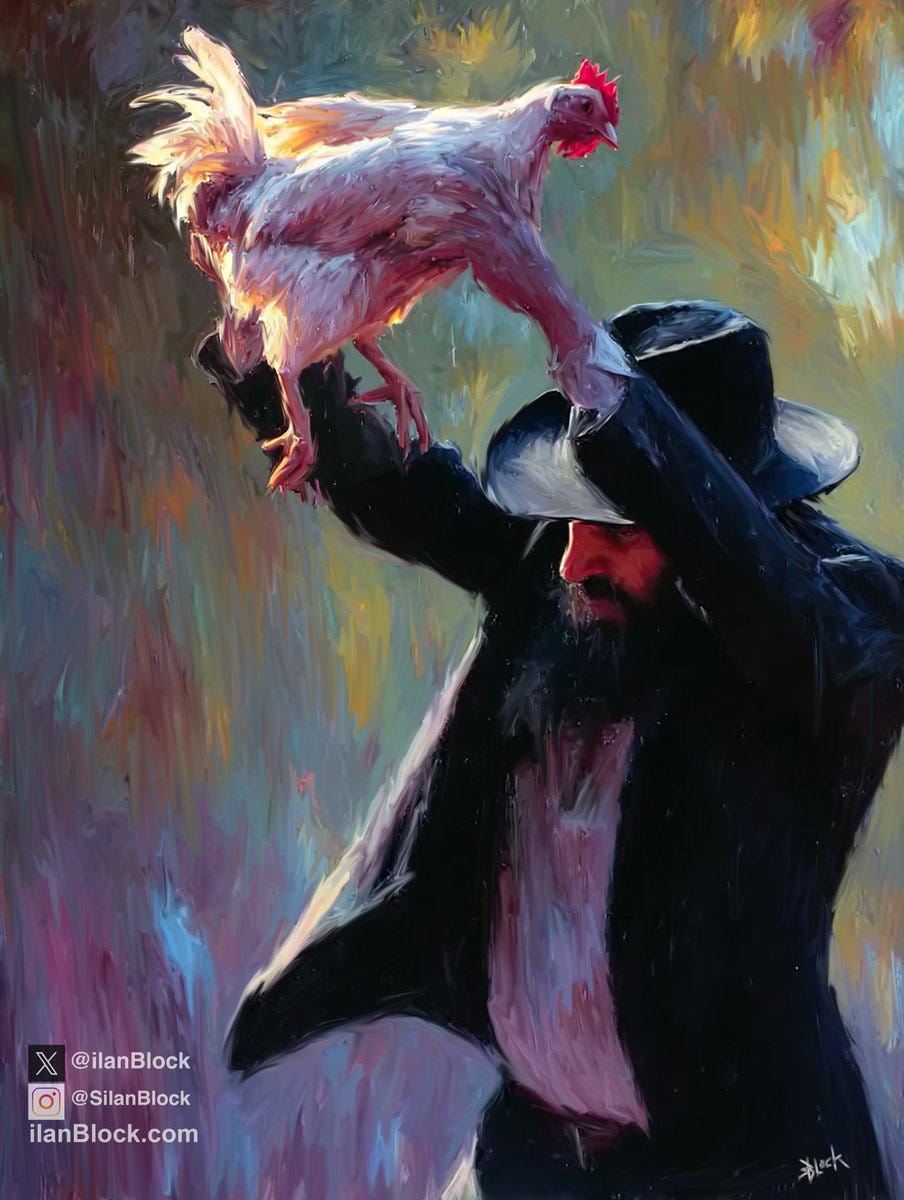
Kapparot is performed over a few days each year, in the week before Yom Kippur, preferably early at dawn on the day before the fast. Just as Yom Kippur translates as Day of Atonement, so too Kapparot, the plural of Kapparah, means atonement. If you’re unclear as to what happens on Yom Kippur, or its significance in the Jewish tradition, this primer should answer most of your questions. If you’re unclear about what Kapparot are, this should help.
As Yom Kippur rolls around, so too do protesters in very Jewish enclaves such as Crown Heights, Boro Park, and Williamsburg, to protest the practice. Before we address their claims, it’s important to distinguish between two very different streams opposing the practice. One seeks to uproot it entirely, while another one seeks to replace it.
An Old Ritual From 2010
The main organized American campaign against Kapparot is the Alliance to End Chicken as Kaporos, and it is associated with United Poultry Concerns. They’ve been organizing protests since 2010. The second campaign comes from PETA and various other animal groups. The third, a recent development, is the product of individual social media personalities, often (or usually) groyper or groyper-adjacent grifters looking to foster antisemitism and generate clicks (to, of course, monetize them). For the sake of this essay, we will ignore the latter two, though their existence deserved a mention for the sake of completeness.
The Alliance’s goal is not to abolish Kapparot. Their aim is to convince Jews to perform Kapparot with money rather than chicken. Their own flyers explicitly tell Jews to “Use Money, Not Chickens.” Their objection, which is serious and not in contradiction with Jewish law, concerns allegations of the Biblical prohibition of Tza’ar Ba’alei Chaim, creating unnecessary harm to animals. They say that the transport, cramped crates, weather conditions, food and water for the chicken, handling, and sometimes rushed or botched shechita are forbidden under Jewish law; therefore, the practice should use money rather than chicken to avoid such violations.
Even the most pro-Kapparot voices will grant that, if there is Tza’ar Ba’alei Chaim, then at the very least, this becomes problematic. While there is no doubt that many, if not most, Kapparot operations follow at least the stringent standards required when industrially slaughtering chicken for public consumption, as concluded in many lawsuits over the years, there is no doubt some individual operations likely have conditions that violate this Biblical principle. And even when an operation functions according to Biblical laws, some participants might violate it through how they handle the chicken themselves.
If there were no other alternatives to Kapparot, and it was a binary of “Do it, or Don’t,” then resistance to changing a tradition that possibly occasionally (or routinely, as some of its detractors claim) violates a Biblical prohibition would be understandable. Since, however, Kapparot can be done with money, or other kosher animals (who doesn’t want to gently swing a live trout over their head, after all?), the question begs to be asked:
Why are so many Jews, including this very author, adamant about doing Kapparot with chicken?
A Talmudic Origin… ?
Part of the controversy is the unclear origin of Kapparot. Rashi on Shabbat 81b quotes a teshuva of the Geonim which describes an older but related ritual: Jews would take a basket of soil, planted with beans or legumes for their children, circle the basket over their head seven times with the formulation of “This is instead of, etc.” as we recite it today, and then throw the basket in a river.
This suggests that, back in the days of the Geonim, Kapparot, or at least a Kapparot-like practice, was common. The Maharal goes further and, in Netivos Olam (Netiv HaBitachon, Perek 1), explains that the principle of exchanging a rooster’s death as atonement and replacement for your death is rooted in the story of Rabbi Akiva, brought in Berachot 60b. Therein is the famous story of Rabbi Akiva’s journey with a candle, donkey, and rooster. As he set down for the night, the wind blew the candle, a cat ate his rooster, and a lion ate his donkey. That very night, soldiers captured the nearby town. If it hadn’t been for his three losses, he would have captured and lost his life. The Talmud concludes, “kol d’avid Rachmana l’tav avid.” Everything Hashem does is for the good.
The Talmud does not conclude that this was a Kapparah, but the Maharal explains that the tradition’s very basis is rooted in this incident, and that it clearly proves it is not only permitted but desirable. Still, others push back and declare that there is no basis for Kapparot anywhere in the Talmud, or the Torah, for that matter. This creates a major disagreement between Ashkenazi and Sefaradi legal authorities. The Rema (Shulchan Aruch Orach Chaim 605) clearly rules that this is a minhag vasikin; that is, a highly praised and ancient custom practiced by those who are pious. The Beit Yosef, by contrast, rules that the practice should not only be avoided, but even prevented.
So why do it at all? And, if, as the activists of the Alliance point out, you can do Kapparot with money, why stick with chicken? Or why do Kapparot at all, then?
Tradition, Tradition, You Shall Pursue
The importance of traditional rituals, known as minhagim, is outside of the scope of this essay. If you’re unfamiliar with them and want to learn more, I suggest you check out the following material.
A minhag is not a Torah mitzvah, and it’s not a universally binding Rabbinic obligation either. That does not mean, on the other hand, that it is not binding on some as an obligation. It doesn’t mean the practice is meaningless, not Judaism, or that there is no reason to defend it. Judaism is replete with important minhagim that are not technically obligatory but are sometimes associated with, or even seen as the main part of, certain rituals or holidays.
Apples dipped in honey, Tashlich, staying all night to learn Torah before Shavuot, eating dairy the morning of, making noise after Haman’s name, dreidels on Chanukah, and Hakafot with Sifrei Torah are all minhagim, yet heavily associated with those days. If we were to eliminate minhagim because they are not min HaTorah, what would those holy days look like? Would they be improved?
Even in communities where Kapparot is a minhag and treated as a quasi-obligatory ritual, using a chicken is not obligatory in itself; money can be used in its stead. Replacing it with money is not a modern invention of animal-rights activists.
Replacement is not the same as eliminating. Our Sages, in Pesachim 50b, say that one should not deviate from established local practices in a way that will create conflict. The Talmud also explains that inherited communal minhag can become binding over enough time.
Charity, Charity, You Shall Pursue
The ritual of Kapparot centers not only on atonement but also on charity. Either money is donated to the poor, or a chicken (or other animal, more on that later) is donated to feed them, as recorded by the Rema. The Alter Rebbe, author of the Shulchan Aruch HaRav, says that redeeming the bird with money can be preferable, so as not to embarrass someone by giving them chicken used for Kapparot.
As mentioned earlier, while a chicken is the standard form, money can be used as an alternative, as can other kosher birds or animals when a chicken is not available. Fish can also be used, as were live vegetables in a basket, per the Geonim’s teshuva mentioned earlier. The only real restriction would be turtledoves or pigeons, as those could be misconstrued as being a sacrifice.
In fact, choosing a chicken partly emphasizes that this is not a sacrifice, or a replacement for a sacrifice. Historically, records show wealthy people in the era of the Geonim using rams as kapparot, recalling the story of the Akeidah, where a ram was offered as a substitute for Yitzhak.
A Deeper Meaning
The pinnacle of the Kapparot ceremony happens as one recites “This is my exchange, this is my substitute, this is my atonement. This chicken shall go to its death, while I proceed to a good, long life and peace.” It is often misunderstood and leads to a few misconceptions:
The main component of Kapparot is still repentance and evoking compassion. The verses quoted previously (from Psalm 107 and Job 33) describe people in darkness and danger, in need of help, crying out to Hashem to save and rescue them. In Job, a person approaches destruction and is then spared; a replacement for his death is found. Kapparot is meant to evoke Biblical passages and imagery to create a feeling of repentance and genuine prayer during the Kapparot ceremony as one carefully passes the bird over his or someone else’s head.
In Judaism, there is no concept of someone or something dying for your sins. To receive atonement, it must come through repentance (teshuva), prayer (tefillah), and good deeds (maasim tovim). Even the sacrifices in the Temple did not effect atonement on their own.
This means that the chicken does not become guilty for your sins, and its death does not magically erase them. Kapparot is not a substitute for repentance, and an unrepentant person does not become innocent because a chicken was slaughtered.
The uses of “exchange, substitute, atonement” are meant to evoke fear and awe about what one’s punishment for sins should be as Yom Kippur approaches. The Rambam, in his Laws codifying repentance, gives a clear ruling at the very beginning, noting that bringing an actual sacrifice in the Temple did not atone until the one bringing the offering performed genuine repentance and confession. You could bring as many sacrifices as you want, you could swing as many chickens as you want, or send as many goats to Azazel as you want; as long as there is no genuine repentance, there is no atonement.
The Shabbat Problem
If there is no death of others to atone for your sins, what do we do with the Talmud in Shabbat 33b, which says that sometimes righteous individuals are taken because of the sins of the generation? Furthermore, Moed Katan 28a mentions that the death of those righteous individuals, in fact, atones!
There are two major differences, namely that we’re discussing the entire people against the individual, and abeyance of punishment to avoid destruction out of mercy, or at least until there is teshuva that is accomplished, versus teshuva being required when it happens.
The death of a righteous person protecting or atoning for the sins of the generation does not mean that anyone, individually, is better off in their own personal situation. They are just as guilty for all of their sins; G-d has simply decreed that, instead of the communal disaster that would have stricken the Jewish people, the righteous person was taken away instead. This is not in lieu of Teshuva, and neither are Kapparot. In the former case, the hope is that the death of the righteous will eventually bring people to repentance, while the latter are meant to bring them to teshuva. We see in Isaiah 1 that G-d rejected the sacrifices at the time, telling Jews to cease doing evil first.
Their commonality is that neither the death of the righteous nor the chicken replaces your own efforts to repent for your sins. You have an obligation to feel regret, confess your sins, genuinely take it upon yourself not to repeat the sin, and then the sacrifice will atone for you. We have many sources, hundreds of years ago, such as the Mahariv Weil, who explained Kapparot this way.
The Animal Cruelty of It All
As I mentioned earlier, there is no doubt that genuine animal cruelty is a serious Biblical prohibition. In fact, this is a universal prohibition not restricted only to Jews. If chickens are mishandled, left in extreme weather, overcrowded, deprived of food or water, injured, or subjected to careless slaughter, this is a genuine concern according to Jewish law.
This is why some people use, or prefer to use, money. R. Ovadia Yosef is a very useful modern example: he still favored chickens when proper treatment and highly reliable shechitah could be guaranteed, and used/preferred money when those conditions could not be guaranteed.
Many of the objections to Kapparot here are based on appearances rather than real problems. “These chickens were not handled or transported properly” is not the same as thinking transporting any live poultry is, by definition, inherently cruel. Witnessing something for the first time when it’s an industry standard and not considered cruelty legally or even ethically is not the same either. Seeing a chicken being slaughtered can be unpleasant, but that doesn’t mean it was inhumane or going to stop someone from buying a pack of boneless chicken breasts at the grocery store. Whether there are a few steps of distance between the processing and the final product doesn’t change that.
Chicken is still, according to the vast majority of opinions, the best way to do kapparot. If the real issue is the conditions during transport and before slaughter, then the solution isn’t to move away from chicken; it is to create mechanisms that ensure proper procedure is followed and the chickens are handled with care from beginning to end. Or, at the very least, according to industry standards. And, according to the many lawsuits filed and lost in New York State against the process, the Kapparot process follows the standard enough that it doesn’t warrant State intervention.
If the argument is that the transport itself, and how the chickens are handled, are inherently Tza’ar Ba’alei Chaim, then the issue is not with Kapporot, but with industrialized poultry, and that’s where the protests should be redirected, and happen all year long, instead of concentrated and restricted to religious neighborhoods prior to Yom Kippur.
If the argument is that some people will mishandle the chicken and cause it undue harm, then again, the answer is not to stop Kapparot, but to educate people on how to do it properly. Either handling the chicken carefully, as those who know how to handle it do, or providing a carton box already alleviates the problem for most.
People can make mistakes or be careless, but extremely few, if anyone, do it to be cruel to the chicken. The vast majority of people tend to be extremely careful for a simple reason:
If you mishandle the chicken, you risk breaking a limb, since they are fragile animals; that means your chicken is not kosher, which defeats the entire point of what you’ve done. No charity will come out of that act, and you’ve most likely committed a grave sin to add to the pile before Yom Kippur.
Jewish authorities are very clear that you have to be extremely careful with how you treat them. You have some people (like me, for example) who will gently put the chicken in a box and close it (often causing the chicken to fall asleep) and wave the box with the chicken in it. This is also why, at least on the Jewish side of things, the transport of chickens, the way they are handled, and how they are slaughtered will be at worst similar to how they’re treated in a non-Jewish slaughterhouse, and if properly observed, far better than they would have been if they had been in such a factory.
Kosher Kosher Slaughter
Another myth, often bundled with accusations of animal cruelty during the handling, but somewhat unrelated, is that kosher slaughter is inhumane. Reality tells us otherwise.
During kosher slaughter, a trained slaughterer called a shochet uses an extremely sharp knife without any defects (they must be inspected every few animals) to swiftly sever the trachea, esophagus, carotid arteries, and jugular veins in one brisk & continuous movement. This leads to an immediate massive blood loss.
This blood loss causes a massive drop in blood pressure to the brain, so the animal loses consciousness within seconds (near-instantaneously for chickens and small livestock) and within moments for adult cattle.
Prior to losing consciousness, they will not feel any pain.
They do not feel pain because the sudden loss of blood supply prevents the brain from processing pain signals, and the rapid loss of consciousness renders the animal unconscious before it can perceive pain. An important rule of kosher slaughter is that only healthy and uninjured animals can be slaughtered for food. This means they need to be well treated from birth til the slaughterhouse, including during transport.
During kosher slaughter, the animal is supposed to arrive at slaughter calm and unhurt, one animal at a time, out of view of other animals. As I’ve repeated many times, creating undue pain to an animal is a grave sin, and that includes during slaughter too
Especially when compared to slaughterhouses. Stunning, an industry standard, usually involves trauma & is far worse than the cut.
I’m not gonna go into details, as that would require a far longer separate thread, but anyone is free to look into how often industrial slaughterhouses misfire bolts, the electrified water baths for upside-down chicken, and all of the horrible things that routinely happen there.
In Conclusion
The modern debate boils down to this: Money, or chicken?
Ultimately, this should be left to the individual to decide what they feel comfortable with, as well as what their family or community minhag is.
I’m not here to dictate one way or another what should be done. Whatever option someone follows, Tza’ar Ba’alei Chaim is not part of the minhag. If a mass operation cannot guarantee proper treatment and shechitah, many significant Orthodox authorities themselves direct people toward money or another properly arranged option. This is what I would do myself, if I could not find an alternative.
Whether you do kapparot or not, charity, prayer, repentance, and good deeds are what matter.
May we all donate tsedeka, daven with kavana for forgiveness, engage in good deeds, and all be inscribed and sealed for a good year.
And G-d willing, we won’t need to fast, as we will be redeemed by our righteous Mashiach before Yom Kippur & we’ll feast in Jerusalem instead!
And, if not, have an easy and meaningful fast!
But, really, let’s hope for Mashiach. Enough is enough.
Using rams for kapparot? I used to work on shearing gangs when I was a uni student. We called the rams 'big boxes,' because they were huge and quite passive. I couldn't see swinging one over your head!
Sorry, animals are sentient beings and don’t deserve to be stressed out by people swinging them around over one’s head . use money and have always done so. Personally, I believe it should be banned!